
This recipe comes from my father, a man who poured his heart into his garden from the first warm days of spring all the way through autumn. He took such pride in every plant he grew and along the way, he passed along one of the most important lessons I carry into my kitchen today: cook with what is in season, and it will never let you down. When summer arrived and the vegetables came in abundance, he was determined that not a single one would go to waste. This dish was his solution. If you find yourself with a garden full of summer vegetables and are not sure what to do with them all, this recipe is the answer. The little cooks in your life can have fun arranging the vegetables in any pattern they like.
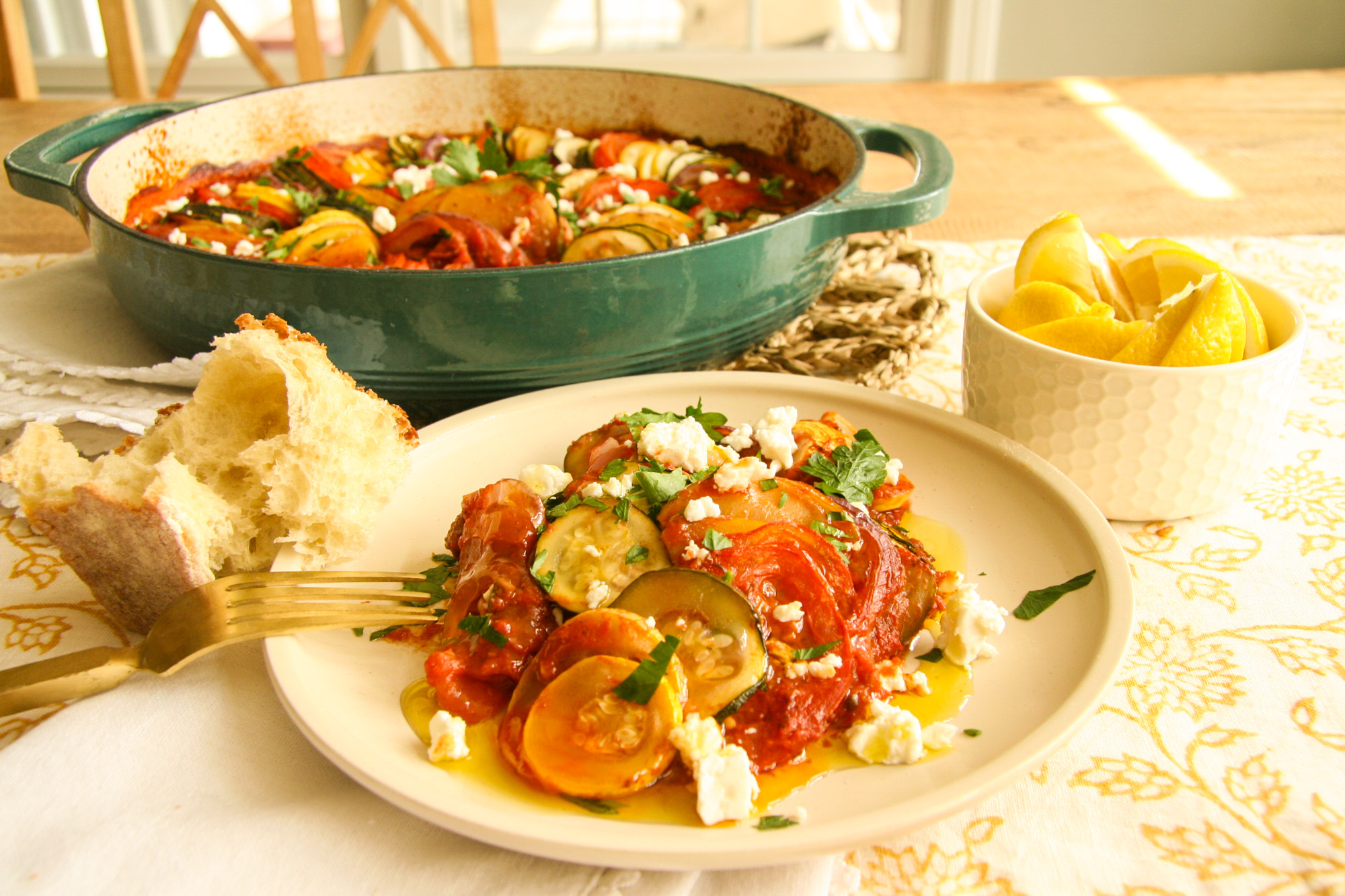
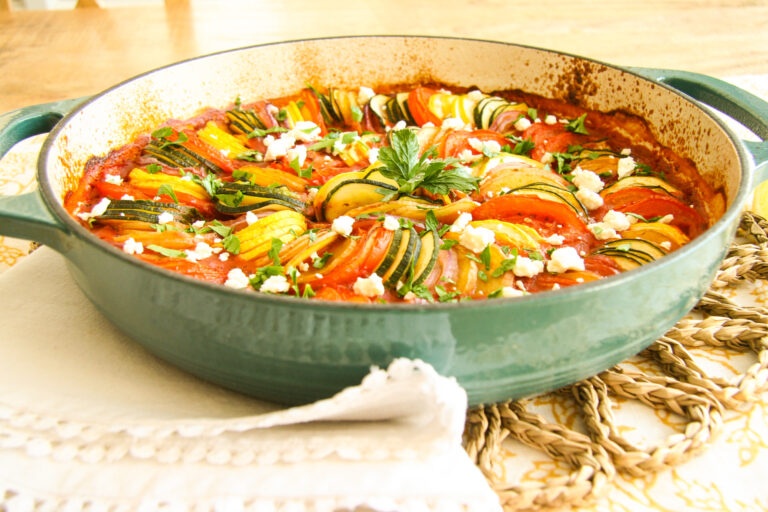
Roasted Summer Vegetables
No two batches of this roasted summer vegetables dish ever look quite the same, and honestly, that's the whole point. Use whatever your garden-or your farmers market- handed you this week, and you really can't go wrong.
- Total Time: 1 hour 15 minutes
- Yield: 6 servings
Ingredients
Sauce Base
• 2 cups tomato puree
• 3 garlic cloves, minced
• 2 tablespoons sundried tomatoes, chopped
• 2 tablespoons chopped olives or olive tapenade
• 2 tablespoons olive oil
• 1 tablespoon dried oregano
• 1 teaspoon paprika
• 1 teaspoon salt
• ½ teaspoon pepper
• Zest of one lemon
Vegetables
• 2 Yukon gold potatoes, thinly sliced
• 3 Roma tomatoes, thinly sliced
• 1 yellow squash, thinly sliced
• 1 zucchini, thinly sliced
• ½ red onion, thinly sliced
For Serving
• Olive oil
• Feta cheese, crumbled
• Fresh parsley, chopped
• Aleppo pepper flakes
• 1 lemon, cut into quarters
Instructions
1. Preheat your oven to 350 degrees.
2. In a bowl, combine all sauce base ingredients. Stir well and pour into your 12-inch round roasting pan, spreading it to cover the entire bottom.
3. Arrange the sliced vegetables in a spiral pattern in the pan, overlapping each slice slightly. You may need to halve some of the larger vegetable slices to keep the arrangement uniform.
4. Cover the pan and bake for 30 minutes. Remove the cover and bake for an additional 15 minutes, or until the top begins to brown. If needed, broil for a few minutes to achieve a golden-brown finish.
5. Remove from the oven and drizzle generously with olive oil. Sprinkle with crumbled feta cheese and fresh parsley. Serve warm with lemon quarters on the side.
Notes
❖ NOTES
This recipe is very flexible, swap in any vegetables your family enjoys. Eggplant, carrots, and sweet potatoes all work beautifully.
For thin, uniform slices, a mandoline works wonderfully. Please note that mandolines are very sharp and should always be handled by an adult. Children should also leave the vegetable slicing to a grown-up, but they are wonderful helpers when it comes to arranging the vegetables in the pan!
We chose feta for this recipe because that is what we had on hand, but many cheeses pair wonderfully with roasted vegetables. Mozzarella, parmesan, or a mild buttery Greek cheese called Kasseri are all excellent choices.
Aleppo pepper, a staple in Mediterranean and Middle Eastern cooking, brings gentle warmth and a subtle sweet-tangy note that builds slowly rather than overwhelming the dish. Swap in red pepper flakes if you can’t find it.
- Prep Time: 30
- Cook Time: 45
- Category: Side Dish
- Method: Roasting
- Cuisine: American, Greek
Language Corner: Roasted Summer Vegetables
These language guides are here to support you, not overwhelm you! Pick one word, one prompt, or one concept that feels right for your child and your moment. There is no right or wrong way to use them. The best conversation is the one that happens naturally while you are cooking together.
✦ Word of the Day: Spiral
A spiral (say it: SPY-rul) is a curve that winds around a center point, getting wider as it goes. In this recipe, we arrange the vegetables in a spiral pattern in the pan, overlapping each slice as we go around.
Try it: "Before we start arranging, can you draw a spiral with your finger on the counter? Now let's try to create that same shape with the vegetables in the pan."
Try it: “What other things have you seen that are shaped like a spiral?” (snail's shell, a galaxy, or the pattern of seeds in a sunflower).
✦ Describing Words
One of the most magical things about roasting vegetables is watching them transform right before your eyes. Before they go in the oven, they are bright, crisp, and raw, full of vivid colors. When they come out, they are golden, tender, and fragrant, their edges just beginning to caramelize. This recipe is a perfect opportunity to practice describing words, adjectives that capture how something looks, smells, tastes, and feels at each stage.
Try it: Take a picture of a vegetable before it goes into the oven for reference. "Describe the vegetable before it goes in the oven. Now describe it again when it comes out. How many words changed?"
✦ Figure of Speech: "In Season"
When we say a vegetable is "in season," we mean it is naturally at its very best right now, grown close to home, full of flavor, and harvested at just the right moment. My father did not go looking for anything special. He simply looked at what his garden was giving him that week and built something beautiful around it. Food in season does not need much help. It already tastes its best.
Try it: "What season are we in right now? Can you think of three vegetables or fruits that are ‘in season’ where we live? What about fruits and vegetables that are ‘in season’ in the fall?”
✦ Talk While You Cook
While slicing the vegetables: "Look at all the different colors we have. If you had to name this dish after one of its colors, what would you call it?"
While arranging the vegetables in the pan: "You are arranging these like a work of art. What pattern are you going for? Is there a pattern you are following, or are you making it up as you go?"
While the pan is in the oven: "The recipe says to cover it first, then uncover it. Why do you think we do it in two steps? What do you think is happening inside the pan right now?"
When it comes out: "Before we add anything on top — just look at it. What three words would you use to describe what you see?"
There are no wrong answers — just good conversation!
✦ Think Like a Chef
A chef never stops asking questions, especially the question: what if? This recipe works beautifully with the vegetables listed, but it is also an open invitation to experiment. What if you swapped the zucchini for eggplant? What if you added thin slices of sweet potato or beet? What if you used a mix of colored tomatoes instead of just Roma? Chefs think about flavor, color, texture, and what is available. A good dish is a starting point, not a finish line.
Try it: "If you could add one vegetable we did not use today, what would it be and why? What do you think it would taste like after 45 minutes in the oven?"
✦ A Note on Kitchen Safety
This recipe is a beautiful one to make together, and there is plenty for little hands to do, from measuring, stirring the sauce, pouring it into the pan, and arranging the vegetables in any pattern they like. Those are the most creative jobs in the whole recipe, and they make the biggest difference in how the dish looks.
However, the slicing belongs to a grown-up. A mandoline slicer, which cuts vegetables into thin, even rounds, is an incredibly useful tool, but it is also extremely sharp and should never be handled by children. A sharp kitchen knife carries the same rule. Adults do the slicing; everyone else takes over from there.
The oven gets very hot, and the pan will hold its heat for a long time after it comes out. Always use oven mitts, set the pan on a heatproof surface, and remind little ones to keep their hands and faces away from the steam.

Leave a Reply