
Some recipes are just food. And then there are the recipes that are something more, a memory, a tradition, a story passed down.
Spanakopita is that recipe for me. My yiayia made it. My mother made it. And now I make it, with a few small twists of my own. This flaky, golden spinach and feta pie is one of the first things I learned to cook, and it remains one of the most requested dishes.
It is also, I have to say, one of the best recipes to make with children. There is layering, brushing, counting, and a word that is absolutely worth learning: phyllo.
Will every child take a bite? Maybe not — and that is perfectly okay. At Tig's Table, we believe that being in the kitchen, touching the ingredients, and talking about the food is just as valuable as eating it. The trying comes with time. The memories start now.
Print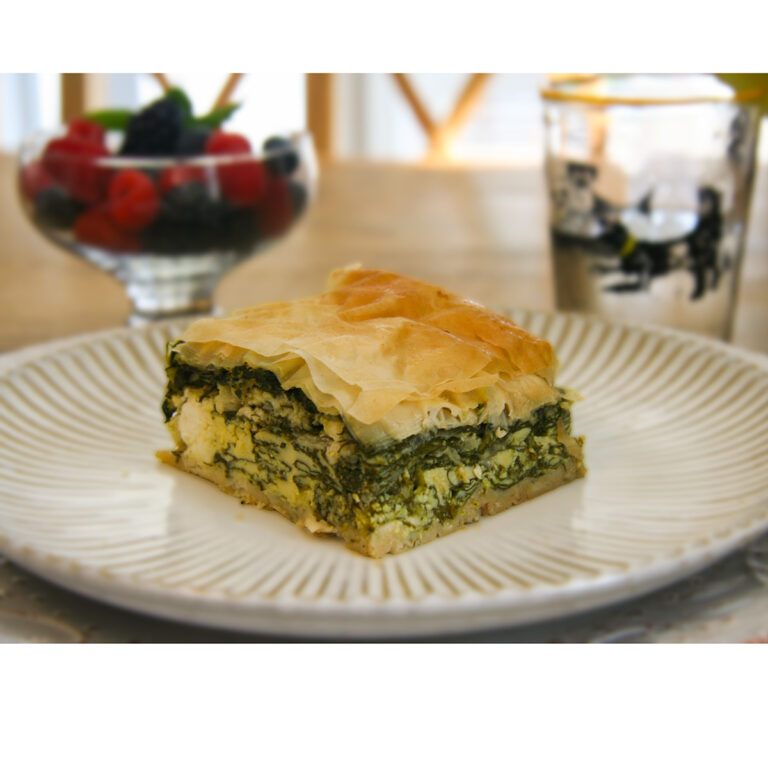
Spanakopita
My yiayia's spanakopita — flaky, golden, and filled with spinach, feta, and family tradition. One of the first recipes I ever learned to make, and still one of the most beloved.
Ingredients
- 2, 10 oz. bags fresh spinach, washed and dried
- 1 yellow onion, chopped
- 4 tablespoons olive oil, divided
- 1 bunch fresh dill, washed and dried
- 1¼ lbs feta cheese (block feta in brine, crumbled)
- 10 eggs, beaten
- 1 box phyllo dough, thawed according to package instructions
- 2 sticks (1 cup) unsalted butter, melted
Instructions
- In a large skillet, sauté spinach in 2 tablespoons olive oil until wilted. Transfer to a large bowl and let cool slightly.
- In the same skillet, sauté onion in remaining 2 tablespoons olive oil until softened. Add to the bowl with spinach.
- Chop dill and add to the spinach mixture.
- Crumble feta and add to the spinach mixture.
- Add beaten eggs and stir to combine all ingredients well.
- Preheat oven to 350°F.
- Melt butter on the stovetop over low heat.
- Remove phyllo from package. Keep covered with a damp kitchen towel as you work to prevent it from drying out.
- Count out 9 sheets from the bottom of the stack and set aside, these will form the top of the pie.
- Brush a 9x13 glass baking dish with melted butter. Layer the remaining phyllo sheets one at a time, brushing each layer generously with butter.
- Once the bottom layers are complete, spread the spinach filling evenly over the phyllo.
- Layer the reserved 9 sheets on top, brushing each with butter.
- Before baking, use a sharp knife to score the top of the pie into your desired serving sizes — small diamonds for appetizers, larger squares for a main or side dish.
- Bake for 45-50 minutes, until the top is deep golden brown.
- Transfer to a wire rack and cool for at least 1 hour before cutting through the score lines.
Notes
Always use block feta packed in brine, it has the best flavor and texture for this recipe.
Keep the phyllo covered with a damp towel the entire time you work. The moment it dries out it becomes brittle and tears easily.
Seasonal twists: In spring and summer, add the zest of one lemon to the spinach mixture for brightness. In fall and winter, add a pinch of nutmeg for warmth.
Language Corner: Spanakopita
These language guides are here to support you, not overwhelm you! Pick one word, one prompt, or one concept that feels right for your child and your moment. There is no right or wrong way to use them. The best conversation is the one that happens naturally while you are cooking together.
✦Word of the Day: Phyllo
Phyllo (say it: FEE-lo) comes from the Greek word for "leaf." It's a paper-thin dough that is layered sheet by sheet to create a light, flaky crust. In spanakopita, dozens of phyllo sheets are stacked and buttered to create that signature golden, crispy top.
Try it: "Can you see how thin each sheet is? What else can you think of that is thin like a leaf?"
✦ Greek Word of the Day
Spanakopita (span-ah-KO-pee-tah) is a Greek word made of two parts:
- Spanaki (σπανάκι) = spinach
- Pita (πίτα) = pie
Put them together and you get: spinach pie! Greek is full of words built this way, two smaller words joined to make a new one. This is called a compound word, and English has them too! Can you think of any? (Hint: cupcake, sunflower, rainbow...)
✦ Word Family: Texture Words
Spanakopita is a recipe full of textures, words that describe how something feels or sounds:
- Flaky — breaks apart in thin layers
- Crispy — makes a crunching sound when you bite it
- Creamy — smooth and soft
- Golden — perfectly cooked to a warm, brown color
Try it: "Before you taste it, can you describe what you think it will feel like? What about after?"
✦ Language Concept: Sequencing
This recipe has steps that must happen in a specific order, if you skip a step or do them out of order, the spanakopita will not turn out right. This is called sequencing.
Try it: "Can you tell me the steps to make spanakopita in order? What would happen if we put the filling in before we layered the phyllo?"
✦ Figure of Speech: "The moment it dries out"
When we say "the moment the phyllo dries out, it becomes brittle," we are talking about cause and effect — one thing causes another to happen almost immediately. "The moment" tells us it happens fast.
Try it: "Can you think of another 'the moment' sentence? Like: the moment it rains..."
✦ Think Like a Chef
This recipe has two seasonal versions — lemon in spring and summer, nutmeg in fall and winter. If YOU were the chef, what ingredient would you add to make this recipe your own?
✦ Talk While You Cook
While washing the spinach: "Why do you think we wash our vegetables before cooking them?"
While layering the phyllo: "We are making layers, can you count how many sheets we have used so far?"
While brushing with butter: "What is happening to the butter as it touches the warm phyllo? What words would you use to describe it?"
While scoring the top: "We are making a pattern with the knife, what shape are we making? Can you think of another way we could cut it?"
While waiting for it to bake: "The kitchen smells amazing right now, can you describe what you smell using at least three words?"
✦ A Note on Kitchen Safety
Little hands learn best when they are close by your side. Please supervise children at all times in the kitchen, especially around hot ovens, sharp utensils, and electric mixers. When in doubt, let them watch and cheer you on — that is learning too!
Leave a Reply